
image source: https://www.biography.com/people/robert-hooke-9343172
Biography of Robert Hooke
Robert Hooke was the physicist who discovered Hooke’s Law. Robert Hooke was born in the town of Freshwater, on England’s Isle of Wight in 1635, an island off the southern coast of England. In 1653, Hooke enrolled in at Oxford’s Christ Church College and worked as an assistant to the scientist Robert Boyle.
In 1662, Hooke became the curator for the experiments for the newly formed Royal Society of London with the support from Boyle. In 1663, Hooke became a fellow of the society.
In 1665, Hooke worked as a professor of geometry at Gresham College in London. Hooke then became a city surveyor after the “Great Fire” destroyed much of London in 1666. He assessed the damage and redesigned many of London’s streets and public buildings.
In Hooke’s last year of life, he suffered from symptoms that may have been caused by diabetes. He then eventually died at the age of 67 in London on March 3, 1703.
What is Hooke’s Law
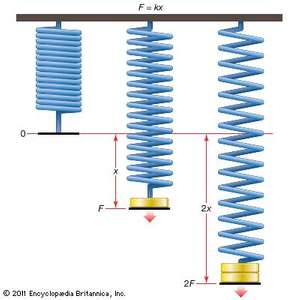
image source: https://www.britannica.com/science/Hookes-law
Hooke’s Law, also known as law of elasticity was discovered by the English scientist Robert Hooke in 1660.
Hooke’s law states that, for relatively small deformations of an object, the displacement or size of the deformation is directly proportional to the deforming force or load. Under these conditions, the object will return to its original shape and size when the load is removed.
A solid may experience deformation when it is stretched, compressed, squeezed, bent or twisted. Thus, a metal wire or spring exhibits elastic behavior according to Hooke’s Law because the extensions of the metal wire doubles each time the force is doubled.
Mathematically, Hooke’s Law states that applied force, F, equals to a constant, k, times the displacement or change in length, x. It is easier to understand when Hooke’s Law is written in formula, which is F=kx. The constant, k, depends on the kind of elastic material and the dimensions and shape of the solid.
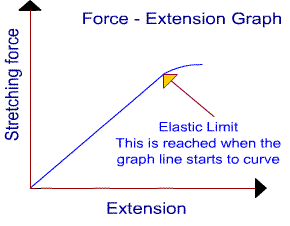
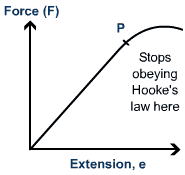
image source: https://schooltutoring.com/help/understanding-hookes-law/ https://www.s-cool.co.uk/a-level/physics/deformation-of-solids/revise- it/hookes-law
Hooke’s Law only describes the elastic properties of materials in which the force and displacement are proportional. It means that if the solid exceed the elastic limit, Hooke’s Law can no longer applied to the solid.
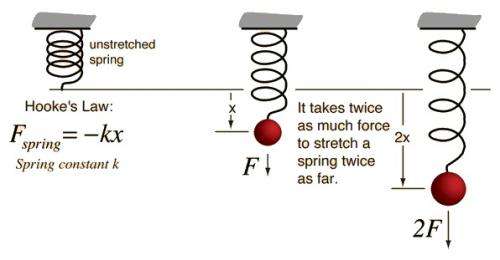
Image source: https://phys.org/news/2015-02-law.html
Sometimes, Hooke’s Law is formulated as F=-kx. In this formula, F is no longer means the applied force but means the equal and oppositely directed restoring force that causes elastic materials to return to their original dimensions.
Experiment of Hooke’s Law
In this experiment, the behaviors of three materials, y1, y2 and z are studied. x is the force applied (in Newtons) to the elastic material. y1 and y2 are the deformation of two different elastic materials but they still in their own linear regions, which means that they do not exceed their elastic limit. However, z describes the behavior of a material which has exceeded its elastic region. This simply means that z is the situation which the material goes past its elastic limit and the material is unable to return to its original shape.
First Experiment:
| x | y1 | y2 |
| 1.00 | 3.00 | 2.26 |
| 2.00 | 4.50 | 4.32 |
| 3.00 | 6.00 | 6.37 |
| 4.00 | 7.50 | 8.43 |
| 5.00 | 9.00 | 10.49 |
| 6.00 | 10.50 | 12.55 |
| 7.00 | 13.00 | 14.61 |
| 8.00 | 14.00 | 16.67 |
| 9.00 | 15.00 | 18.72 |
Table 1: Result for the experiments for material y1 and y2
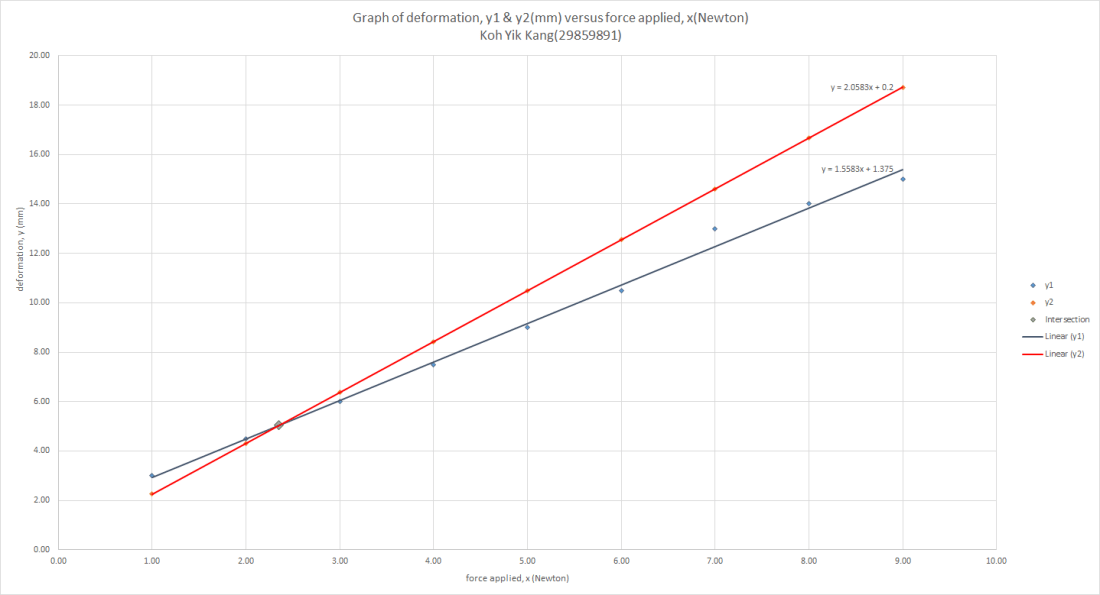
Graph 1: Graph of y1 & y2 versus x
Table 1 shows the result of deformation of the material, which are y1 and y2 when increasing force, which is x, is applied to the material.
Graph 1 shows the relationship between deformation, y1 and y2, and the force applied, x. The graph clearly shows that both deformation y1 and y2 is directly proportional to the force applied, x.
From graph 1, the equations of line y1 and y2 are obtained.
The equation of y1 is y1 = 1.5583x + 1.375.
The equation of y2 is y2 = 2.0583x + 0.2.
The interception of both y1 and y2 can be calculated easily as the equations of both graphs are obtained.
y1 = y2
1.5583x + 1.375 = 2.0583x + 0.2
0.5x = 1.175
x = 2.35
The value of x is then put into the equation y1.
1.5583(2.35) + 1.375 = 5.037
Therefore, the intersection point of line y1 and y2 is (2.35 , 5.037).
The formula Hooke’s Law is F=kx. The equation of this experiments is y=ax+b while a is the gradient. If the formula is rearranged, the formula of this experiment is x=(1/a)(y-b). Then, the value of k is 1/a. The value of k is the reciprocal of the gradient. After that the k, which is the force constant of the material can be found.
Force constant of material y1:
k = 1/a
k = 1/1.5583
k = 0.64 N/m
Force constant of material y2:
k = 1/a
k = 1/2.0583
k = 0.49 N/m
The force constant of material y1 is 0.64 N/m, while the force constant of material y2 is 0.49 N/m.
Second Experiment:
| x | z |
| 1.00 | 2.375 |
| 2.00 | 9.375 |
| 3.00 | 28.375 |
| 4.00 | 65.375 |
| 5.00 | 126.375 |
| 6.00 | 217.375 |
| 7.00 | 344.375 |
| 8.00 | 513.375 |
| 9.00 | 730.375 |
Table 2: Result of experiment for material z
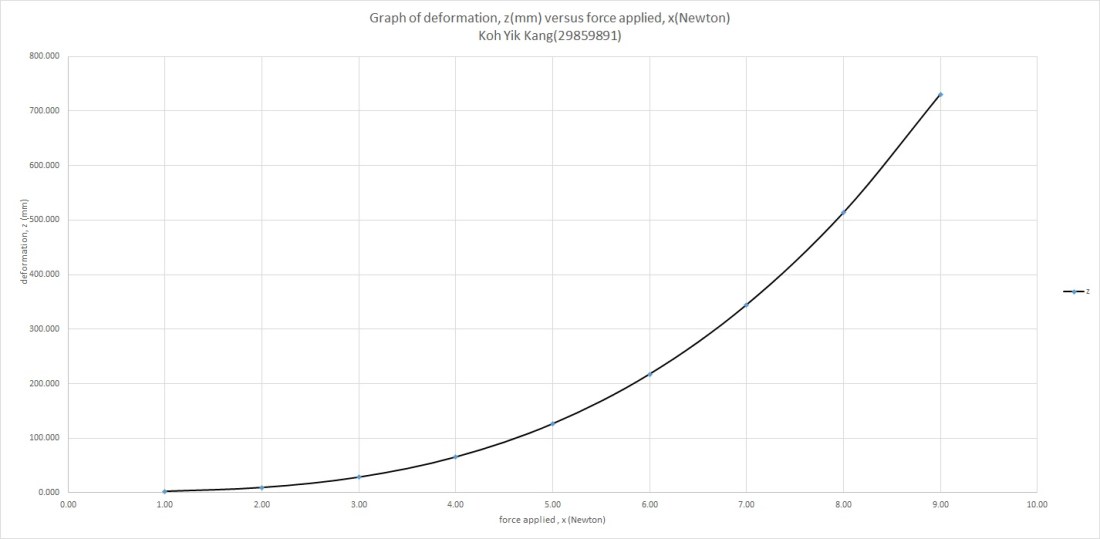
Graph 2: Graph of z versus x
Table 2 shows the result of deformation of the material, which is z, when increasing force, which is x, is applied to the material.
Graph 2 shows the relationship between the deformation, z, and the force applied, x. However, Graph 2 is different from Graph 1. In Graph 2, the deformation, z, is not directly proportional to the force applied, x. The reason of this situation is that the material of the second experiment has exceeded its own elastic limit, means that the material used in second experiment can no longer return to its original size or shape.
Source of Error:
Some possible error which affect the experiment results may occur during the experiments.
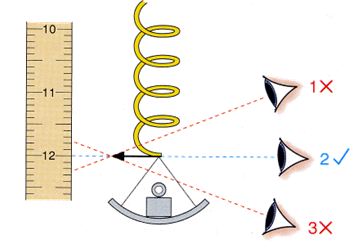
Image source: https://www.antonine-education.co.uk/Pages/Physics_3/ISA_05/ISA_05.htm
Human error especially parallax error may occur when taking the reading from the apparatus. Parallax error occurs when the reading is viewed from an angle due to the wrong position of the eye. Therefore, the reading taken may be slightly lower or higher. To prevent parallax error, the eye of the observer should be placed directly perpendicular to the reading on the apparatus. Besides, the experiment should be repeated at least three times in order to calculate the average reading so that the results can be more accurate.
Conclusion:
In the first experiment, deformation y1 and y2 is directly proportional to the force applied, x. Both material of y1 and y2 does not exceed their own elastic limit. Therefore, Hooke’s Law is obeyed in the first experiment.
In the second experiment, deformation z is not directly proportional to the force applied, x. The deformation z increases when the force applied, x, increases. The material of z has exceeded its own elastic limit and is is unable to return to its original size or shape. Hooke’s Law is not obeyed in the second experiment.
Reference:
https://www.biography.com/people/robert-hooke-9343172
https://www.britannica.com/science/Hookes-law
https://www.britannica.com/science/elastic-limit

 Koh Yik Kang